23 Şubat 2013 Cumartesi

Mayor Bloomberg - 'Let Them Eat Pain!'

To contact us Click HERE
Now lets keep in mind that State and Federal Governments have already been putting restrictions on these types of medicines, some of which need to be accounted for pill-by-pill. But since drug addicts are still finding ways to obtain these drugs, the Mayor's next plan to fight this kind of drug abuse is to take the drugs away from those who will legitimately benefit from them. This is not really a surprise given that this is the same solution he has for combating gun crime, basically targeting those who legally own and would like to legally own weapons.
Mayor Bloomberg's latest rant is that he is going to restrict the availability of painkillers to people who need them at NY area hospitals. His reasoning is that there are people in New York City who are addicted to them. This however will do nothing but punish responsible people who do not abuse these medications, leaving some in pain.
“Number one, there’s no evidence of that. Number two, supposing it is really true, so you didn’t get enough painkillers and you did have to suffer a little bit. The other side of the coin is people are dying and there’s nothing perfect … There’s nothing that you can possibly do where somebody isn’t going to suffer, and it’s always the same group [claiming], ‘Everybody is heartless.’ Come on, this is a very big problem.” - Politicker
So because people are dying from prescription medicine abuse, abuse that I have no control over, the Mayor's logic is that I must have less or even no pain killers because people who don't need it, are consuming too much. 

As for Mayor Bloomberg's comment that some people are just going to have to suffer a little bit, this is the same guy who can't suffer for a minute and wait for his car to cool down on a hot summer day and has his car cooled down by a custom-made air conditioner system. All this from the same guy who puts strict anti-idling laws in place and then breaks them.
Enough with the politicians who think they are better than the rest of us. If we are going to start openly treating people as part of distinct social classes, then lets do it all the way. This way we can stop treating the majority of the population like crap because of a tiny minority. Lets single out this tiny minority and give them the fair treatment that they have earned.

--------------------
Add to Google
--------------------

Proscecution of Gun Crime Goes Down Under Democrat Presidents

To contact us Click HERE
It is interesting to note that Democrats are calling for new gun laws but at the same time they are refusing to enforce existing gun laws. Take the national background check for purchasing a firearm. Thousands of people who are not allowed to purchase a firearm are stopped each year during the background check process. Many of these people caught lying on their applications in an attempt to illegally purchase a firearm. Almost none of these cases are prosecuted. This was highlighted in a recent post. Even the (mostly) distasteful Mayor of New York, Mayor Bloomberg, finds this a truly inexcusable act of neglegence o behalf of the Government.
Some, including New York City Mayor Michael Bloomberg, are also pressing the Justice Department (DOJ) to get more aggressive in going after those convicted of trying to buy firearms by filing fraudulent background information. Citing 2009 figures, Bloomberg hammered the DOJ recently for prosecuting only 77 of 71,000 cases where people were found to have lied on their background checks."These are gun criminals trying to buy guns illegally – and the federal government is just letting them walk," Bloomberg said during a speech in December. - The Hill
The Sandy Hook shooter tried to buy a gun a couple days before his attack. How many other dangerous people have tried and simply been turned away with no follow-up by the Federal Government? Do we have to wait until they too start shooting people? 

This kind of inaction is nothing new. Under President Clinton, there were complaints that his Administration was not serious in going after gun criminals. Worse, the then Administration actually hailed the law as working simply because they stopped and turned away criminal gun purchases. This would be like catching a bank robber, taking the money that he stole and then sending him on his way and calling it a success. this is sheer insanity.
President Clinton, Al Gore and their Congressional anti-gun allies continue to hold up the Brady Act as an effective crime-fighting tool, but they can`t explain why the 500,000 felons, drug dealers, stalkers and fugitives who walked into federally licensed dealers to purchase guns illegally were simply turned away. They committed multiple federal felonies, crimes punishable with 10-year prison terms. But these felons, drug dealers, stalkers and fugitives were not arrested. They were not prosecuted. They didn`t go to prison, and no community was made safer. - NRA ILA (17 October 2000!)
How many other crimes did these half million criminals who were left on the streets commit during the time that they could have been behind bars. How many people did they kill as a result of failure of the Government to put them in jail? I am going to make a guess that it was more than one. As our current Vice President notes, action should be taken if it can save even just one life. So how about enforcing our existing laws. That should save many more than one life...
Biden talked also about taking responsible action. "As the president said, if you're actions result in only saving one life, they're worth taking. But I'm convinced we can affect the well-being of millions of Americans and take thousands of people out of harm's way if we act responsibly."

Biden, as he himself noted, helped write the Brady bill. - The Weekly Standard
Well Mr. Vice President, how about pushing for the Brady Bill to be enforced...

Federal Prosecutions of Criminal Use of Guns
FY 1992-1998
You know that this is bad when even the NRA is complaining that the Government needs to do more to put gun criminals behind bars....

As I have said before, Democrats want gun criminals on the streets. Otherwise they loose a campaign issue. Gun crime victims mean little to Democrats other than votes on election day. If they really cared about the people they would push for putting gun criminals behind bars.
--------------------
Add to Google
--------------------

Idiot Politician of the Day - Republican Senator John McCain

To contact us Click HERE
John McCain is a Republican Senator from Arizona. He ran for President against Barack Obama and lost. I voted for John McCain because he would have been a better President than Barack Obama. That does not mean that Senator McCain is not an idiot. Being an idiot is not what cost him the election, especially given that he lost the election to an even worse Senator. That said, if this is what Senator McCain thinks counts as serving his country, then I say that Senator McCain has served our Country long enough.
Earlier, the former Republican presidential nominee said he expects Hagel to be confirmed as defense secretary even though he doesn’t plan to vote for him.
“I don’t believe he is qualified,” McCain said. “But I don’t believe that we should hold up his nomination any further.” - HotAir.com
Senator McCain is playing old-school Senate games. The President however is counting on the Republican Senators to play by these rules as he breaks them and uses them to his advantage. After all, it was President Obama who declared that the Senate was on recess so that he could push through some of his political appointees that the Senate was holding pro-forma sessions specifically to prevent the President from appointing without confirmation from the Senate.
Senator McCain has become a useful idiot and an enabler of the left. Take the calls for more gun control. Lets forget that the Democrat suggestions and demands are unreasonable. You don't hear Senator McCain defending the rights of Americans. No. Instead he is eager to find compromise with the democrats. This compromise will be at the expense of our rights. And for what? So that Senator McCain can continue to be a big-ish man in Congress. Forget it.
The point of Senate Confirmation is to ensure that Presidential appointees are competent and qualified to serve in the positions that they have been appointed to. If you think that Hagel is unqualified, than do what you can to keep this unqualified idiot from a position in charge of the Pentagon.Senators have such powers, especially when they act together. McCain would rather move along. That is unfortunate. Many people busted their asses working to help McCain become President. It would be nice if McCain busted his ass once in a while in return...
Given that you can't teach this old dog any new tricks, can't we just send him home.
--------------------
Add to Google
--------------------

Philadelphia Perpetuates the Myth To Clamp Down On Public Feedings of the City's Most Vulnerable and Poor

To contact us Click HERE
Philadelphia Mayor Michael Nutter has yanked a page straight out of the old "Quality of Life" crimes playbook to inflict some shiny new misery on people who are already challenged to survive on a daily basis.

Waaaayyy back in November 2007, the National Coalition for the Homeless (NCH) and the National Law Center on Homelessness & Poverty (the Law Center) worked collaboratively to publish Feeding Intolerance: Prohibitions on Sharing Food with People Experiencing Homelessness. Back then, they provided a spreadsheet that listed the US cities that had some sort of ordinance or ban on street feeding:
 Almost 6 years later, not much has changed and in fact, this spreadsheet is woefully outdated today because a number of new cities need to be added, including Nashville and now, Philly (and Nashville initiated theirs so long ago that it's barely worth mentioning and is only listed here because I happen to live here). 

Why, you might ask, are Mayors like Nutter still justifying their actions years later based on debunked excuses for implementing punitive measures on peeps who are hungry?

Well, Mayors across the country participate each year via via The U.S. Conference of Mayors’ Task Force on Hunger and Homelessness, and they strategize on how best to eradicate homelessness.  The U.S. Conference of Mayors is the official nonpartisan (supposedly, anyway) organization of cities with populations of 30,000 or more. There are 1,139 such cities in the country today, each represented in the Conference by its chief elected official, the Mayor.


Now I would really like to think that all these participating Mayors were honestly interested in ending homelessness by providing real options for their city and the people who're experiencing perhaps one of the most traumatic and challenging times of their lives. This real policy change is accomplished by promoting housing-first strategies and approaches for the city's most vulnerable, ensuring a well-trained staff of direct service providers, and facilitating a collaborative and coordinated cross-agency effort that utilizes evidence-based and promising practices empirically proven to end - not manage - homelessness. 

But I also know that these approaches are not always fully embraced by communities - at first, anyway.  And money is tight in every city, as we're all painfully aware.  I also know that trying to navigate through the political land mines saturating the field of social policy choices bring with it high risk for those who're considering pushing upstream against the currents of the mighty river of Status Quo. 

I've got more than a sneaking suspicion that because these risks, should they go bad, have very high consequences to the good Mayors; and because those experiencing homelessness don't contribute to campaigns; nor are they typically a block of courted voters, since they don't usually vote (with any regularity, anyway); our Mayors tend to take a path of least resistance in terms of potential political ramifications and execute the "end" of homelessness through illusion, rather than through good, solid systemic policy change. 

And that path of least resistance seems to usually culminate in the Mayor of a given city, in this most recent case, Philadelphia, the "City of Brotherly Love," trotting out these lame justifications for the enactment of quality of life criminalization measures rather than to tackle the real issues related to the systemic problems that often lie at the root of an individual's homelessness, hunger, and poverty....    

Posted at 02:37 PM ET, 08/23/2012

In Philadelphia parks, churches fight to feed the homeless

By Charles C. Haynes Church ministries have been feeding homeless people in Philadelphia’s public parks for decades – not as a charitable gesture, but as an act of faith.
But earlier this year, city officials passed an ordinance banning public feeding of groups of more than three people in any city park – taking care, of course, to exempt city-sanctioned special events, family picnics and other gatherings the city finds more palatable.
The law targets church groups and charities that give meals to the homeless on land along the Benjamin Franklin Parkway, home to major museums such as the Philadelphia Museum of Art and the newly opened Barnes Foundation art collection.
Why make it so hard to feed the homeless in the City of Brotherly Love?
Philadelphia Mayor Michael Nutter’s official explanation for the ban is that he wants to move feeding the homeless inside (though the city is vague about how or when this will happen). Moreover, the city argues, church feeding programs are health hazards that create a mess in the park. The mayor offered part of the plaza surrounding City Hall as a temporary alternative location.
Religious leaders dismiss the city’s objections to meal distribution in public parks as bogus, pointing out that no one has gotten sick from the food distributed and volunteers clean up the space used. Moreover, many of the homeless who live in the park are reluctant to travel elsewhere (leaving their few possessions) – and some are too disabled to do so.
According to critics of the law, the real reason for the ban is the proximity of the feeding programs to tourist attractions, especially the new $150 million building housing the Barnes Foundation collection that opened in May.
To stop the law from taking effect, religious groups (with support from the American Civil Liberties Union) filed suit in federal court charging that prohibiting churches from feeding the homeless in city parks violates religious freedom ( Chosen 300 Ministries, Inc. v. City of Philadelphia).
The city responded by claiming that because the law “imposes no restrictions upon praying or preaching or reading the Gospel or engaging with the homeless,” the ban on feeding doesn’t interfere with the churches’ right to practice their faith.
In July, U.S. District Judge William H. Yohn, Jr., rejected the city’s argument and granted a temporary injunction barring implementation of the law. In a written opinion issued two weeks ago explaining his order, the judge wrote that government has no business ascribing some of the churches’ religious activities more religious significance than others.
To support his conclusion that the park feeding ban violated the religious freedom of the ministries, Yohn relied not on the First Amendment, as might be expected, but on the Pennsylvania Religious Freedom Protection Act.
That’s because the U.S. Supreme Court weakened the protections of the First Amendment’s free exercise clause in 1990, declaring that government no longer had to show a compelling state interest before denying religious exemptions to generally applicable government laws that substantially burden the free exercise of religion ( Employment Division v. Smith ).
In response to the court’s 1990 ruling, some states – including Pennsylvania – have passed legislation restoring the “compelling interest” test.
According to Yohn, Philadelphia’s public feeding ban would likely fail that test because the city has not shown that governmental interests are strong enough to override religious freedom in this case. Moreover, the city has not provided a truly viable alternative for relocating the feeding programs.
Philadelphia is not the only city trying to move homeless people and those who serve them out of public parks. According to the National Law Center on Homelessness and Poverty, more than 50 other cities have passed anti-camping and anti-feeding ordinances.
Nutter is appealing the court injunction. But whatever happens in the courts, church leaders in Philadelphia promise to keep the meals coming – even if it means defying the law.
After all, when it comes to helping “the least of these,” they believe in obeying a higher law.
By Charles C. Haynes  |  02:37 PM ET, 08/23/2012

" I totally understand the 'no money, no mission' paradigm. I also know that without collaboration and resource sharing, true, lasting change is not possible."

To contact us Click HERE
Dr. Centrone elucidates a common situation those experiencing homelessness know all too well in just about every city in the country.  It is certainly true that in some towns providers have more effectively collaborated to accomplish far more together than they ever could have individually, but the truth is that even in most of those places, increased collaboration among agencies, services and resource allocators continues to be elusive and below the level that is actually available.

Homeless services have never been at the top of the priorities list for funding opportunities from their local, state and federal purse-holders.  They've always had to fight for very scarce resources and for a very long time, because so little was known about both the numbers of homeless in a given community and how best to serve them, oversight was....tepid; how does one provide oversight if one doesn't know the scope of - or the remedy(ies) needed to - correct the problem?  

As a result, agencies have learned to be protective of their funding streams while at the same time figuring out for themselves how best to address the niche they carved out as a result of the funding stream.

Let me explain:
 WARNING: BRAIN GLAZING FUNDING INFORMATION COMING!
grants are narrowly targeted. It's not like an agency can send in a "proposal" with a vague and overly broad request to "help people who are homeless" to someone like Housing and Urban Development (HUD) or the Substance Abuse and Mental Health Services Administration (SAMHSA)  That proposal must be pretty specific to the announcement of funding opportunity (a Request For Proposal/RFP. or Request for Application/RFA).  As a result, organizations often find themselves building their approach around a specific RFP, which then also essentially ties their hands to remain within the parameters of the requirements laid out in the RFP.

Because these funds originate at the Federal level (usually), it's challenging, to say the least, for Federal policy makers seeking to provide some help to local entities for their problems or issues to know exactly what this might entail.  They work around this in a couple of ways; first, by providing "block grants" to states so that the state itself can decide what priorities it will set and then release RFPs for the available funds. Second, the feds put out federal RFPs (duh) targeting specific approaches known as Evidence Based Practices (EBPs) or Promising Practices.   

Understand I'm being overly broad and vague myself on this as I don't want to put you to sleep, nor am I in any way, shape or form a Subject Matter Expert (SME) on grants and funding procurement.  But I do know probably just enough about them to be dangerous to myself and others with it, and part of this danger I think many of us share when we apply for funding at the local level.

This is because as I mentioned earlier, we find ourselves tied to the requirements - and the restrictions - within the grant itself.  And if the grant is disbursed over a period of years, as many of them can be, whole departments; hell, whole organizations may be built upon them.

This is a key point, because what then becomes an issue - sometimes the overarching issue - is keeping that funding in order to keep the staff employed in order to keep bringing the service(s) to the population being served; the “no money, no mission” paradigm. 

There's little incentive to collaborate or to share resources because a. the requirements of the grant narrow the scope of what the agency is able to do, and b.the agency is already running on a shoestring and the last thing they want to do is to give a competitor for those scarce resources any of the goodies - or the inside info around the grant requirements -  they worked their tails off to get for themselves. There's also little incentive to change funding streams, since winning a grant is always "iffy" and it used to be much easier to write a continuation application rather than a new RFP. 

Let be LOUD and clear here; agencies DO want to collaborate, and they often DO SO even when they know it can be potentially harmful to the funding they receive for the job they're doing.  It's just that for a very long time, there wasn't really a directive to find ways to to collaborate, nor was there a paradigm shift from - and this is a critically important point - managing homelessness to ending homelessness. 

Over the last 5-7 years, the Federal government has ramped up their investigative efforts around homelessness and have begun to understand much more clearly the scope of the problem. This in turn has helped to identify the remedies needed to accomplish this shift.

What they've discovered is what most folks on the ground providing services have known for quite some time; the precursors leading to - as well as the issues chaining people to - homelessness are varied, complex, and there is no "one size fits all" answer.

And, s it is so often, when we figure out one thing, new challenges and barriers suddenly materialize or come more sharply into view as a result.

Now one of the bigger problems we're all facing is getting people to understand the need for the paradigm shift from management of homelessness to the idea of ending homelessness, and this is no easy task.  People have some very deeply held beliefs around the causes and conditions of homelessness, and there are widely held stereotypical beliefs that, while often erroneous, continue to be pervasive and hard to eliminate.

All of this "discovery" and tactical shifting takes time, especially when it must come from something like the Federal government, who is as far removed from the realities of the daily life on the ground in Murfreesboro, TN or Round Rock, TX or Davenport, IA., as is a citizen of Zimbabwe.

The key here of course is to raise awareness, but it is also to ensure that as money flows from federal to state to local programs, those programs are evaluated based on outcomes tied tightly to ending - not managing - homelessness.  If, as your program has contact with individuals experiencing homelessness, you are releasing them back onto the streets when your "treatment" is complete rather than being able to release them into housing, we need to rethink continuing funding to this organization under a homeless services grant. 
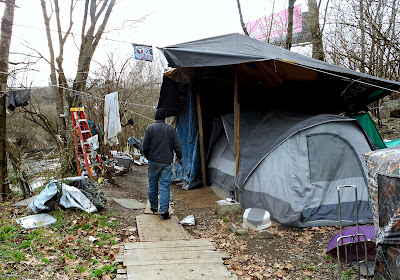
Let me be crystal clear here; services to address the immediate needs of those experiencing homelessness are essential and must be continued.  HOWEVER, these services should NOT be stand alone services, and we must begin to hold agencies accountable for helping to end homelessness with every individual they engage with who is currently experiencing homelessness. If your service is not directly connected in some way, shape or form in the measurable reduction of people experiencing homelessness in your community, funding for your program should come from some other source to allow the scarce dollars allocated to homelessness to be used solely to assist with ending it. 

I know this sounds a little extreme, but if we want to reduce the costs associated with homelessness and bring an end to the scourge itself, there is only one real answer:
we must put people into houses. 

Slaying the Ego in Homeless Services Delivery by Wayne Centrone

Posted on by C4 Thought
At the end of our talk today at the San Diego, California Region IX Health Care for the Homeless Conference, I had an opportunity to speak with a service provider. He told me about his efforts to get organizations to build a coalition in his community. He told me about the six months it took him to schedule the first meeting of the homeless services agencies in his area.
He told me that he had not given up hope that the coalition will pay off with great dividends. I complimented him on his efforts and reassured him that his efforts would indeed pay off. I told him that he may never know the impact of his efforts, but, I told him, if his efforts led to ending the experience of chronic homelessness for one person, then it was worthwhile.
I enjoy speaking at these conferences. They are full of amazing people working in homeless services. I love to reconnect with old friends, inspiring thought leaders, and change agents. The people who work in homeless health clinics, supportive housing programs, mental health and substance use treatment programs around the country are gifted and courageous people.
I spoke at this conference with my colleague Steven Samra. We talked about our work on a new model of outreach we are calling “Housing-Focused Outreach” (HFO). Steven and I, along with the leadership and thoughtful intellect of Ken Kraybill, have been incubating the ideas of HFO for a few years. Our ideas are not unique. They are born from the work of Dr. Sam Tsemberis at Pathways to Housing, and the visionary work of the 100,000 Homes Project. Our ideas are also born from our years of experience in serving people experiencing homelessness and the work we have all been doing over recent years in visiting supportive housing programs around the United States.
The talk was about shifting the paradigm of service delivery. We are considering how to develop and operationalize a new model to impact agency level activities. A summary of our conversation, a work in progress, looks like this:
(1) In order to truly end chronic homelessness, we [homeless service providers, peers, and advocates] need to lead with housing and build effective bridges to supportive services.
(2) The only way to ensure adequate access to housing and supportive services is to build bridges of collaboration with a number of organizations and resources.
We talk about the fact that most communities around the country have the pieces to put together a really effective model to end chronic homelessness. The issue, however, is that these pieces are fractured and disjointed from one another. Our main predicate for the Housing Focused Outreach model is training service providers to be experts in building partnerships.
When we give this talk, we hear repeatedly how little collaboration actually occurs on the ground. I hear over and over again at talks like this: “Oh, that [collaborating with partner agencies] won’t work . . . we are all fighting for the same pot of money, and we can’t really collaborate or we will lose our agency level effectiveness.”
Don’t get me wrong, I totally understand the “no money, no mission” paradigm. I also know that without collaboration and resource sharing, true, lasting change is not possible. I am not sure how we can get more people invested in the idea that collaboration is one of greatest and most underutilized tools. One thing I do know: it will take some serious ego slaying and a strong commitment to service.

22 Şubat 2013 Cuma

TIPS for February 21

To contact us Click HERE
Get your FREE programs!
Daytona Beach Thu E, Race 13 #3: R Booze Cruise

Gulf Greyhound Thu E, Race 05 #8: KILLER DOTTY

Orange Park Thu E, Race 13 #1: Gs Nike

Palm Beach Thu A, Race 05 #3: Superior Scammer
Palm Beach Thu A, Race 14 #2: Algoa Runaway

Southland Thu E, Race 03 #6: Jovita
Southland Thu E, Race 05 #6: Hl's Matt

Derby Lane Thu E, Race 01 #7: Hl's Joe America
Derby Lane Thu E, Race 05 #1: Edna Oakley
Derby Lane Thu E, Race 08 #7: Se's Chick Click
Derby Lane Thu E, Race 15 #8: Pd Dark Force

Results: Dogs to Watch for February 20

To contact us Click HERE
Get your FREE programs!
DODGE CALIBER, Birmingham, 02/20/2013, Evening, race 9 post #2. Result: 8-3-1- .

RK'S CONK GONK, Palm Beach, 02/20/2013, Afternoon, race 14 post #6. Result: 1-6-2- .

MISTIE BASS, Southland, 02/20/2013, T, race 20 post #3. Result: 1-3-8- .

TWISTING TWISTER, Derby Lane, 02/20/2013, Afternoon, race 6 post #8. Result: 4-7-5- .
VENUS ESPINOSA, Derby Lane, 02/20/2013, Evening, race 10 post #3. Result: 6-1-7- .


GAME PLANE, Tucson, 02/20/2013, Evening, race 5 post #4. Result: 4-2-6- .

Visit trackinfo.com for complete entries and program pages.