11 Aralık 2012 Salı

Philadelphia Perpetuates the Myth To Clamp Down On Public Feedings of the City's Most Vulnerable and Poor

To contact us Click HERE
Philadelphia Mayor Michael Nutter has yanked a page straight out of the old "Quality of Life" crimes playbook to inflict some shiny new misery on people who are already challenged to survive on a daily basis.

Waaaayyy back in November 2007, the National Coalition for the Homeless (NCH) and the National Law Center on Homelessness & Poverty (the Law Center) worked collaboratively to publish Feeding Intolerance: Prohibitions on Sharing Food with People Experiencing Homelessness. Back then, they provided a spreadsheet that listed the US cities that had some sort of ordinance or ban on street feeding:
 Almost 6 years later, not much has changed and in fact, this spreadsheet is woefully outdated today because a number of new cities need to be added, including Nashville and now, Philly (and Nashville initiated theirs so long ago that it's barely worth mentioning and is only listed here because I happen to live here). 

Why, you might ask, are Mayors like Nutter still justifying their actions years later based on debunked excuses for implementing punitive measures on peeps who are hungry?

Well, Mayors across the country participate each year via via The U.S. Conference of Mayors’ Task Force on Hunger and Homelessness, and they strategize on how best to eradicate homelessness.  The U.S. Conference of Mayors is the official nonpartisan (supposedly, anyway) organization of cities with populations of 30,000 or more. There are 1,139 such cities in the country today, each represented in the Conference by its chief elected official, the Mayor.


Now I would really like to think that all these participating Mayors were honestly interested in ending homelessness by providing real options for their city and the people who're experiencing perhaps one of the most traumatic and challenging times of their lives. This real policy change is accomplished by promoting housing-first strategies and approaches for the city's most vulnerable, ensuring a well-trained staff of direct service providers, and facilitating a collaborative and coordinated cross-agency effort that utilizes evidence-based and promising practices empirically proven to end - not manage - homelessness. 

But I also know that these approaches are not always fully embraced by communities - at first, anyway.  And money is tight in every city, as we're all painfully aware.  I also know that trying to navigate through the political land mines saturating the field of social policy choices bring with it high risk for those who're considering pushing upstream against the currents of the mighty river of Status Quo. 

I've got more than a sneaking suspicion that because these risks, should they go bad, have very high consequences to the good Mayors; and because those experiencing homelessness don't contribute to campaigns; nor are they typically a block of courted voters, since they don't usually vote (with any regularity, anyway); our Mayors tend to take a path of least resistance in terms of potential political ramifications and execute the "end" of homelessness through illusion, rather than through good, solid systemic policy change. 

And that path of least resistance seems to usually culminate in the Mayor of a given city, in this most recent case, Philadelphia, the "City of Brotherly Love," trotting out these lame justifications for the enactment of quality of life criminalization measures rather than to tackle the real issues related to the systemic problems that often lie at the root of an individual's homelessness, hunger, and poverty....    

Posted at 02:37 PM ET, 08/23/2012

In Philadelphia parks, churches fight to feed the homeless

By Charles C. Haynes Church ministries have been feeding homeless people in Philadelphia’s public parks for decades – not as a charitable gesture, but as an act of faith.
But earlier this year, city officials passed an ordinance banning public feeding of groups of more than three people in any city park – taking care, of course, to exempt city-sanctioned special events, family picnics and other gatherings the city finds more palatable.
The law targets church groups and charities that give meals to the homeless on land along the Benjamin Franklin Parkway, home to major museums such as the Philadelphia Museum of Art and the newly opened Barnes Foundation art collection.
Why make it so hard to feed the homeless in the City of Brotherly Love?
Philadelphia Mayor Michael Nutter’s official explanation for the ban is that he wants to move feeding the homeless inside (though the city is vague about how or when this will happen). Moreover, the city argues, church feeding programs are health hazards that create a mess in the park. The mayor offered part of the plaza surrounding City Hall as a temporary alternative location.
Religious leaders dismiss the city’s objections to meal distribution in public parks as bogus, pointing out that no one has gotten sick from the food distributed and volunteers clean up the space used. Moreover, many of the homeless who live in the park are reluctant to travel elsewhere (leaving their few possessions) – and some are too disabled to do so.
According to critics of the law, the real reason for the ban is the proximity of the feeding programs to tourist attractions, especially the new $150 million building housing the Barnes Foundation collection that opened in May.
To stop the law from taking effect, religious groups (with support from the American Civil Liberties Union) filed suit in federal court charging that prohibiting churches from feeding the homeless in city parks violates religious freedom ( Chosen 300 Ministries, Inc. v. City of Philadelphia).
The city responded by claiming that because the law “imposes no restrictions upon praying or preaching or reading the Gospel or engaging with the homeless,” the ban on feeding doesn’t interfere with the churches’ right to practice their faith.
In July, U.S. District Judge William H. Yohn, Jr., rejected the city’s argument and granted a temporary injunction barring implementation of the law. In a written opinion issued two weeks ago explaining his order, the judge wrote that government has no business ascribing some of the churches’ religious activities more religious significance than others.
To support his conclusion that the park feeding ban violated the religious freedom of the ministries, Yohn relied not on the First Amendment, as might be expected, but on the Pennsylvania Religious Freedom Protection Act.
That’s because the U.S. Supreme Court weakened the protections of the First Amendment’s free exercise clause in 1990, declaring that government no longer had to show a compelling state interest before denying religious exemptions to generally applicable government laws that substantially burden the free exercise of religion ( Employment Division v. Smith ).
In response to the court’s 1990 ruling, some states – including Pennsylvania – have passed legislation restoring the “compelling interest” test.
According to Yohn, Philadelphia’s public feeding ban would likely fail that test because the city has not shown that governmental interests are strong enough to override religious freedom in this case. Moreover, the city has not provided a truly viable alternative for relocating the feeding programs.
Philadelphia is not the only city trying to move homeless people and those who serve them out of public parks. According to the National Law Center on Homelessness and Poverty, more than 50 other cities have passed anti-camping and anti-feeding ordinances.
Nutter is appealing the court injunction. But whatever happens in the courts, church leaders in Philadelphia promise to keep the meals coming – even if it means defying the law.
After all, when it comes to helping “the least of these,” they believe in obeying a higher law.
By Charles C. Haynes  |  02:37 PM ET, 08/23/2012

" I totally understand the 'no money, no mission' paradigm. I also know that without collaboration and resource sharing, true, lasting change is not possible."

To contact us Click HERE
Dr. Centrone elucidates a common situation those experiencing homelessness know all too well in just about every city in the country.  It is certainly true that in some towns providers have more effectively collaborated to accomplish far more together than they ever could have individually, but the truth is that even in most of those places, increased collaboration among agencies, services and resource allocators continues to be elusive and below the level that is actually available.
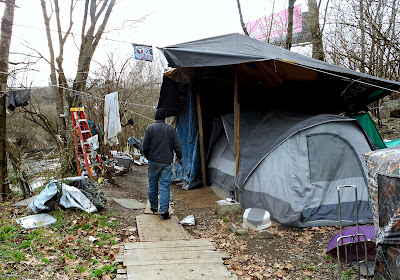
Homeless services have never been at the top of the priorities list for funding opportunities from their local, state and federal purse-holders.  They've always had to fight for very scarce resources and for a very long time, because so little was known about both the numbers of homeless in a given community and how best to serve them, oversight was....tepid; how does one provide oversight if one doesn't know the scope of - or the remedy(ies) needed to - correct the problem?  

As a result, agencies have learned to be protective of their funding streams while at the same time figuring out for themselves how best to address the niche they carved out as a result of the funding stream.

Let me explain:
 WARNING: BRAIN GLAZING FUNDING INFORMATION COMING!
grants are narrowly targeted. It's not like an agency can send in a "proposal" with a vague and overly broad request to "help people who are homeless" to someone like Housing and Urban Development (HUD) or the Substance Abuse and Mental Health Services Administration (SAMHSA)  That proposal must be pretty specific to the announcement of funding opportunity (a Request For Proposal/RFP. or Request for Application/RFA).  As a result, organizations often find themselves building their approach around a specific RFP, which then also essentially ties their hands to remain within the parameters of the requirements laid out in the RFP.

Because these funds originate at the Federal level (usually), it's challenging, to say the least, for Federal policy makers seeking to provide some help to local entities for their problems or issues to know exactly what this might entail.  They work around this in a couple of ways; first, by providing "block grants" to states so that the state itself can decide what priorities it will set and then release RFPs for the available funds. Second, the feds put out federal RFPs (duh) targeting specific approaches known as Evidence Based Practices (EBPs) or Promising Practices.   

Understand I'm being overly broad and vague myself on this as I don't want to put you to sleep, nor am I in any way, shape or form a Subject Matter Expert (SME) on grants and funding procurement.  But I do know probably just enough about them to be dangerous to myself and others with it, and part of this danger I think many of us share when we apply for funding at the local level.

This is because as I mentioned earlier, we find ourselves tied to the requirements - and the restrictions - within the grant itself.  And if the grant is disbursed over a period of years, as many of them can be, whole departments; hell, whole organizations may be built upon them.

This is a key point, because what then becomes an issue - sometimes the overarching issue - is keeping that funding in order to keep the staff employed in order to keep bringing the service(s) to the population being served; the “no money, no mission” paradigm. 

There's little incentive to collaborate or to share resources because a. the requirements of the grant narrow the scope of what the agency is able to do, and b.the agency is already running on a shoestring and the last thing they want to do is to give a competitor for those scarce resources any of the goodies - or the inside info around the grant requirements -  they worked their tails off to get for themselves. There's also little incentive to change funding streams, since winning a grant is always "iffy" and it used to be much easier to write a continuation application rather than a new RFP. 

Let be LOUD and clear here; agencies DO want to collaborate, and they often DO SO even when they know it can be potentially harmful to the funding they receive for the job they're doing.  It's just that for a very long time, there wasn't really a directive to find ways to to collaborate, nor was there a paradigm shift from - and this is a critically important point - managing homelessness to ending homelessness. 

Over the last 5-7 years, the Federal government has ramped up their investigative efforts around homelessness and have begun to understand much more clearly the scope of the problem. This in turn has helped to identify the remedies needed to accomplish this shift.

What they've discovered is what most folks on the ground providing services have known for quite some time; the precursors leading to - as well as the issues chaining people to - homelessness are varied, complex, and there is no "one size fits all" answer.

And, s it is so often, when we figure out one thing, new challenges and barriers suddenly materialize or come more sharply into view as a result.

Now one of the bigger problems we're all facing is getting people to understand the need for the paradigm shift from management of homelessness to the idea of ending homelessness, and this is no easy task.  People have some very deeply held beliefs around the causes and conditions of homelessness, and there are widely held stereotypical beliefs that, while often erroneous, continue to be pervasive and hard to eliminate.

All of this "discovery" and tactical shifting takes time, especially when it must come from something like the Federal government, who is as far removed from the realities of the daily life on the ground in Murfreesboro, TN or Round Rock, TX or Davenport, IA., as is a citizen of Zimbabwe.

The key here of course is to raise awareness, but it is also to ensure that as money flows from federal to state to local programs, those programs are evaluated based on outcomes tied tightly to ending - not managing - homelessness.  If, as your program has contact with individuals experiencing homelessness, you are releasing them back onto the streets when your "treatment" is complete rather than being able to release them into housing, we need to rethink continuing funding to this organization under a homeless services grant. 

Let me be crystal clear here; services to address the immediate needs of those experiencing homelessness are essential and must be continued.  HOWEVER, these services should NOT be stand alone services, and we must begin to hold agencies accountable for helping to end homelessness with every individual they engage with who is currently experiencing homelessness. If your service is not directly connected in some way, shape or form in the measurable reduction of people experiencing homelessness in your community, funding for your program should come from some other source to allow the scarce dollars allocated to homelessness to be used solely to assist with ending it. 

I know this sounds a little extreme, but if we want to reduce the costs associated with homelessness and bring an end to the scourge itself, there is only one real answer:
we must put people into houses. 

Slaying the Ego in Homeless Services Delivery by Wayne Centrone

Posted on by C4 Thought
At the end of our talk today at the San Diego, California Region IX Health Care for the Homeless Conference, I had an opportunity to speak with a service provider. He told me about his efforts to get organizations to build a coalition in his community. He told me about the six months it took him to schedule the first meeting of the homeless services agencies in his area.
He told me that he had not given up hope that the coalition will pay off with great dividends. I complimented him on his efforts and reassured him that his efforts would indeed pay off. I told him that he may never know the impact of his efforts, but, I told him, if his efforts led to ending the experience of chronic homelessness for one person, then it was worthwhile.
I enjoy speaking at these conferences. They are full of amazing people working in homeless services. I love to reconnect with old friends, inspiring thought leaders, and change agents. The people who work in homeless health clinics, supportive housing programs, mental health and substance use treatment programs around the country are gifted and courageous people.
I spoke at this conference with my colleague Steven Samra. We talked about our work on a new model of outreach we are calling “Housing-Focused Outreach” (HFO). Steven and I, along with the leadership and thoughtful intellect of Ken Kraybill, have been incubating the ideas of HFO for a few years. Our ideas are not unique. They are born from the work of Dr. Sam Tsemberis at Pathways to Housing, and the visionary work of the 100,000 Homes Project. Our ideas are also born from our years of experience in serving people experiencing homelessness and the work we have all been doing over recent years in visiting supportive housing programs around the United States.
The talk was about shifting the paradigm of service delivery. We are considering how to develop and operationalize a new model to impact agency level activities. A summary of our conversation, a work in progress, looks like this:
(1) In order to truly end chronic homelessness, we [homeless service providers, peers, and advocates] need to lead with housing and build effective bridges to supportive services.
(2) The only way to ensure adequate access to housing and supportive services is to build bridges of collaboration with a number of organizations and resources.
We talk about the fact that most communities around the country have the pieces to put together a really effective model to end chronic homelessness. The issue, however, is that these pieces are fractured and disjointed from one another. Our main predicate for the Housing Focused Outreach model is training service providers to be experts in building partnerships.
When we give this talk, we hear repeatedly how little collaboration actually occurs on the ground. I hear over and over again at talks like this: “Oh, that [collaborating with partner agencies] won’t work . . . we are all fighting for the same pot of money, and we can’t really collaborate or we will lose our agency level effectiveness.”
Don’t get me wrong, I totally understand the “no money, no mission” paradigm. I also know that without collaboration and resource sharing, true, lasting change is not possible. I am not sure how we can get more people invested in the idea that collaboration is one of greatest and most underutilized tools. One thing I do know: it will take some serious ego slaying and a strong commitment to service.

When Cops Go Good

To contact us Click HERE
I spend a lot of time listening to my brothers and sisters on the street rail against what a good and decent person would probably consider crimes against them perpetrated by police officers acting under the color of authority and laws designed specifically to cause hardship and used for coercive purposes (e.g. "trespassing waivers" that are "on file" at the police department and therefore do not have to  be posted in a spot visible so that you know when you stand under an awning of a business on a city sidewalk that your are in fact trespassing upon that business's location). 

I know that a great many cops have become hardened to the plight of those experiencing homelessness because let's face it and be real and honest; there are times when some folks experiencing homelessness have acted in inappropriate and illegal ways, and I'm not talking here about activities associated with their survival (like breaking into closed building in the middle of the night when the temperature is below freezing. Not saying this is okay or acceptable behavior, but I am saying that the perpetrator is clearly acting in a self-preserving way here and has no interest in stealing, destroying, or otherwise molesting the premises once they've gained entrance). 

The old adage "one bad apple" stands pretty tall here, especially for cops, and most cops with any real street time under their equipment belts will tell you that police work changes your perceptions about humankind and makes them a little more cynical, suspicious, and less likely to be swayed by tales of hardship, excuses, etc.

But just like those of you reading this piece who noticed I was extremely careful to say "'some' folks experiencing homelessness" as I described the situation, it's unfair to lump all cops into the "bad" category because of the actions of a few "rotten apples" within the ranks of our men and women in blue. 

Case in point of course is the action of NYPD officer DePrimo, whose act of kindness, compassion and humanity was caught on camera by a passerby. 

But the truth is, DePrimo's act I think is replicated hundreds of times every month, all over the country, by cops doing the real "protect and serve" duty they swore themselves to do when they joined the force; we just don't see or hear about them.

Now, I believe I know this because I've had the incredibly good fortune to work alongside cops who I know are good and kind and decent people at their core.  One officer in particular, Nashville city police officer Andrea Swisher, who I've written about before here, comes immediately to my mind, but there are others - many others - who do unbelievably good and kind and humane things for people who often don't get a second glance from many in the community.

And before any of you think I'm somehow slanted towards the efforts of police, let me assure you that I've been the victim of an incredibly hateful and targeted campaign by crooked cops to destroy me, and they damn near did, so I come to the table with my own bias towards cops who behave badly.

But I'm smart enough to recognize that blanket assumptions about a particular group of people are not only worthless, they're dangerous and unfair on more levels than I could possibly list here.  It does none of us any good to lump all cops into a "crooked" or "bad" category when at the same time, we ask them to stop doing this same exact behavior to those who find themselves on the street. 

Officer DePrimo, Officer Swisher, and hundreds of thousands of other officers stand as prime examples to this, and don't request or require anything in return.  At a time in our country when it seems like everyone asks "what's in it for me," this is refreshing, honorable, and admirable, indeed.


 Officer DePrimo's kind act (via NYPD Facebook page) (Credit: Jennifer Foster of Florence, AZ)
http://www.salon.com/2012/11/29/cop_gives_boots_to_homeless_man_becomes_online_sensation/


Cop gives boots to homeless man, becomes online sensation

While campaigns against police brutality struggle for attention, one heartwarming NYPD-promoted photo goes viral


The NYPD have received the gift of holiday-period good P.R.: A tourist in Times Square snapped a photo of an NYPD officer giving a pair of boots and warm socks to a barefoot homeless man. The image — an undeniably heartwarming scene of protection and service — became an online sensation once the NYPD posted it to its Facebook page on Tuesday. More than 370,000 users “liked” it as of Thursday morning, and over 109,000 shared it.
Officer Larry Deprimo, the cop who gifted the boots and reportedly told the recipient, “I have these size 12 boots for you, they are all-weather. Let’s put them on and take care of you,” showed the sort of human kindness worthy of sharing online and “IRL” (in real life). Little wonder the NYPD would use the photo of Deprimo as an image boost over social media. There is, however, something galling about the viral celebration of the image as something representative of NYPD’s attitude toward the homeless when there is an ongoing battle by homeless advocates in New York to combat mistreatment by cops. Equally, it’s worth noting that images of severe police brutality get far less online attention. Meanwhile, reporters and citizen journalists have repeatedly in the past year been physically prevented from filming NYPD aggression.
Bronx-based homeless organizing group Picture the Homeless has for over 10 years been conducting a citywide civil rights campaign specifically aimed at curbing police abuses against individuals sleeping on the streets. PTH highlighted that police regularly use force, arrest and ticket homeless individuals for “disorderly conduct” without citing an offense, essentially (and technically illegally) criminalizing homelessness.
“The NYPD has been on a warpath against the homeless, going back decades,” Jean Rice, a PTH member and longtime civil rights campaign leader, told Salon Thursday, adding, “The kindness of one individual officer is a drop in the ocean of the NYPD’s pattern and practice of violating homeless people’s civil rights. The level of corruption and illegal police behavior that exists in our current city government has not been seen since Teddy Roosevelt  was this city’s police commissioner. Random acts of kindness and mere cosmetic adjustments will not provide the progressive reform that disproportionately communities of color in this city need to ensure their survival.”
Through surveys and testimonies, PTH is building a case for a possible lawsuit against the NYPD. This hard-fought and ongoing campaign does not, of course, detract from Officer Deprimo’s generosity, but it does highlight a counter-narrative about the NYPD that is deserving of vastly more attention.
The disturbing footage of two NYPD officers brutalizing a shirtless, shoeless homeless man found sleeping in a Brooklyn Jewish community center is not undone or counteracted by the photo of Deprimo giving a homeless man boots, nor does the brutality undo the kindness — that’s not how it works. But the NYPD is an institution and should be judged as far as possible by the sum of its acts and effects. Thus, when evidence of police goodness is splashed over social media at a rate and an extent far outweighing evidence of brutality, it’s clear that some skewed judgment of the institution is being produced.
It’s worth noting too that in New York and other major cities, journalists both professional and citizen have been prevented on numerous occasions from filming or photographing police acting aggressively or brutally. Famously, journalists and photographers were physically removed (some with force) and cordoned off at a distance while police evicted Occupy Wall Street’s Manhattan base in Zuccotti Park last year. A New York Times freelance photographer was on one occasion arrested and on one occasion physically roughed up by NYPD officers attempting to photograph arrests (which is legal in New York). It was only this week that the Supreme Court ruled against Illinois prosecutors seeking to enforce a law that banned people from filming police. Items of media showing police kindness must then be viewed in a context wherein conveying police wrongdoing has been prevented both legally (in some states) and at street level.

Ending The Ignorance Around Mental Illness And The Potential for Recovery, One Example At A Time

To contact us Click HERE

SAMHSA has been at the forefront of trying to rectify the misconceptions, ignorance, and assumptions around mental illness, addiction, and the potential for full and holistic (health, home, community, purpose) recovery for a very long time now and this has not been an easy effort, I assure you.  

I know this, because I currently toil in the wasteland between the field of Addiction and Mental Health, endeavoring - with so many others - to build a bridge between them both.  This of course is in addition to attempts to raise the awareness and remove the misconceptions, ignorance, and assumptions of the general public and frankly among many individuals within each cohort of service providers.   

 Some days, it truly feels as if we've all collectively been banging our heads against the wall while speaking into the proverbial black hole, so I've come to appreciate on a much deeper level information that helps dispel the ignorance in a succinct and concise way. 

Case in point:

Do people really recover? And if so, why don't I see them?


Philippe Pinel, often considered the father of psychiatry, wrote in 1808, "To consider madness as a usually incurable illness is to assert a vague proposition that is constantly refuted by the most authentic facts" (Pinel, 2008). Pinel, in fact, reported a recovery rate of 93 percent for people who had been admitted to his hospital within a year of onset of their mental health difficulties and who had not received prior treatment at an asylum (treatment that was often violent and that Pinel viewed as detrimental). Similar recovery rates were seen in other moral treatment retreats prior to the creation of large State mental hospitals, which unfortunately came to resemble the pre-moral treatment-era asylums in providing primarily custodial care in overcrowded institutions.

It is from this approximately 100-year period of large asylums, between 1850 and 1950, that we owe our beliefs about the incurability of mental illnesses and why the questions above have become two of the most common raised by mental health professionals when confronted with the long-term outcome literature that has been consistently produced since the 1970s (Carpenter & Strauss, 1974; Harding et al., 2005; Strauss & Carpenter, 1974).

45–65% of people diagnosed with schizophrenia will recover from the disorder over time.This literature suggests that between 45 percent to 65 percent of people diagnosed with schizophrenia—the most severe of the severe mental illnesses—will recover from the disorder over time. The recovery rate Harding and colleagues (Harding, Brooks, & Ashikaga, 1987; Harding et al., 1987b) found in rural Vermont was around 65 percent, while a World Health Organization study found about 45 percent in Boston and Washington, D.C. (World Health Organization, 2001). These are the percentages of people who recovered fully (that is, no longer appeared to have any signs or symptoms of mental illness). The percentages for people who experienced significant improvements would be even higher than that. In contrast, most studies found only about 20 percent to 25 percent of any given sample experiencing a deteriorating course over time (Carpenter & Strauss, 1991; Davidson & McGlashan, 1995; Harding et al., 1987a; Harding et al., 1987b).

Despite the consistent literature documenting recovery over the last 40 years, this good news still has not made its way into the training of most mental health professionals. So, many mental health professionals, when exposed to this body of research, ask the questions above. If so many people get better, then why don't I ever see them? A reasonable enough question, to be sure, and one to which there are several answers.

Clinicians do not see people who are, or when they are, well.The first answer comes from a husband-and-wife team of statisticians in the 1980s, Cohen and Cohen (1984), who wrote the seminal paper cited below about what they described as the "clinician's illusion"; in essence, a sampling error of patients within the clinical setting. The Cohens showed that people who work in clinical settings, i.e., clinicians, see people who are ill when they are most ill and often only when they are ill; clinicians do not see people who are, or when they are, well. If I only see you when you are sick, I am going to assume that you are always sick. And if I work in a clinical setting, and therefore typically see people when they are sick, I am likely to draw the erroneous conclusion that the people I see are always sick. What I may not stop to consider is that I am not seeing people who are well because they are, in fact, doing well.

In less-ambiguous or better-understood illnesses, there may be no such illusion. For example, for a pediatric nurse practitioner in an endocrinology clinic, a reasonable assumption when she doesn't see a teenager in her clinic is that the teen is probably doing fine in managing his or her diabetes. When the teen gets sick, then she would see him or her, either in the clinic or in the hospital, but otherwise, odds are that things are basically okay. What has been different in psychiatry is the legacy of the 100-plus years previously noted, during which people diagnosed with serious mental illnesses were confined to institutions and assumed to be chronically and seriously ill, often for the remainder of their adult lives.

This 100-year period of institutionalization both gave birth to, and perpetuated, the belief that these conditions were permanently disabling. As it turns out, what was permanently disabling was being confined to an institution, not the conditions themselves (Davidson, Rakfeldt, & Strauss, 2010; Gullickson, 2004; World Health Organization, 2001). Since the end of that era, epidemiologic and longitudinal studies have found that many people do well over time, and that when they do well, they often see no reason to seek or use mental health services (Narrow et al., 2000). As a result, mental health professionals in fact do not see these people, at least not as patients in public sector settings. They do, of course, encounter people with mental health conditions all the time, in their families, in the grocery store or mall, at the Parent¬–Teacher Association or swim club meetings, at work and at social events, in their neighborhood, and at church, synagogue, or mosque. But since people do not introduce themselves as having a history of psychiatric disability, there is no way of knowing that history unless the person chooses to disclose it.

Some people respond to the explanation provided above by saying that their own experiences suggest a different picture, in which they encounter people who had dropped out of treatment but who were having even more difficulties than when they were in care, rather than fewer. They wonder about the people who they see on the streets, in homeless shelters, or in prisons, or who show up at a later time having experienced significant deterioration in both their mental and physical health; phenomena that appear to be more common, perhaps, in urban areas. Doesn't the presence of such people with serious mental illnesses who, by almost any criteria, are not recovering over time call into question the very notion of recovery? More succinctly stated: is the clinician's illusion really an illusion after all?

It unfortunately is true that most, if not all, of us have had such experiences of seeing people who are not in treatment and who are struggling with significant difficulties. It is a tragedy that there are any such people out there, but this is not only due to the severity of the mental illness. It also is due to multiple system failures and a cascade of harmful social determinants, such as poverty, unemployment, limited education, prejudice and stigma, poor health and lack of access to health care, and other social inequities.

There are, however, many more people out there doing well—but you would have no way of knowing who they are unless they told you about their experiences with illness. And since people are more likely to remember those people they see over and over again, they tend to generalize from those clients who may be having the most difficulty to all clients, past, present, and future. As a consequence, we assume that the folks who we see who are still struggling with significant difficulties are in the majority, while research suggests they are not.

So while the people we see on the streets, in homeless shelters, in prisons, or in hospitals are certainly there, they comprise "only" about one out of four or five of the people who have had the illness for that period of time. If you stop to consider how many people you typically will see over a 20-year career in mental health, and compare that to how many people you have seen who remained very sick for an extended period of time, you most likely will end up with around the same number. This number is, of course, not trivial (which is why we put quote marks around "only"), and the challenges faced by these individuals are not to be overlooked or trivialized. If anything, their presence should inspire us to redouble our efforts to promote recovery among all people affected by mental illness.

But the fact that one out of four or five people may experience significant distress and disability for an extended period of time with our current treatments does not justify rejecting the reality of recovery. Research shows that many of those deemed most profoundly disabled by the illness at any given time nonetheless recover fully at a later point, meaning that there is currently no way to predict who will recover, when, or to what degree. To treat any individual as if his or her fate were predetermined and hopeless based on a psychiatric diagnosis—as in any other chronic illness—is to limit the resources and imagination of both clinicians and clients. To apply this thinking to the entire range of people with the disorder also goes against the primary ethical responsibility of health care practitioners, to "first, do no harm."

The fact that 1 out of 4 or 5 people may experience significant distress and disability for an extended period of time with our current treatments does not justify rejecting the reality of recovery.
As a result of being underresourced and overworked—as well as having few, if any, opportunities to see people recovering and doing well—practitioners have been denuded of hope, as many clients have as well. Yet, as in many other serious health conditions (of which serious mental illness is one), a broad range of clinical outcomes is possible at any juncture. Despite the medical breakthroughs of the last half-century, for example, many people continue to die of cancer. This fact does not dissuade us from doing everything we can to ensure their access to effective care, to encourage quality in their lives, and to promote their recovery in the face of serious illness; neither should it do so when the illness in question is a mental illness.

Article on Clinician's Illusion:
P. Cohen & J. Cohen. (1984). The clinician's illusion. Archives of General Psychiatry, 41, 1178–82.

A selection of outcome studies from the past 30 years:
Ciompi, L. (1980). The natural history of schizophrenia in the long-term. British Journal of Psychiatry, 136, 413–20.

Harding, C.M.; Brooks, G.W.; Ashikaga, T.; Strauss, J.S.; & Brier, A. (1987). The Vermont Longitudinal Study of persons with severe mental illness, I: Methodology, study sample, and overall status 32 years later. American Journal of Psychiatry, 144, 718–26.

Harding, C.M.; Brooks, G.W.; Ashikaga, T.; Strauss, J.S.; & Brier, A. (1987). The Vermont Longitudinal Study of persons with severe mental illness, II: Long-term outcome of subjects who retrospectively Met DSM-III criteria for schizophrenia. American Journal of Psychiatry, 144, 727-735.

Strauss, J.S., & Carpenter, W.T., Jr. (1974). Characteristic symptoms and outcome in schizophrenia. Archives of General Psychiatry, 30, 429–34.

Strauss, J.S., & Carpenter, W.T., Jr. (1972). The prediction of outcome in schizophrenia I: Characteristics of outcome. Archives of General Psychiatry, 27, 739–46.

Strauss, J.S., & Carpenter, W.T., Jr. (1974). The prediction of outcome in schizophrenia II: Relationships between predictor and outcome variables. Archives of General Psychiatry, 31, 37–42.

Strauss, J.S., & Carpenter, W.T., Jr. (1977). Prediction of outcome in schizophrenia III: Five-year outcome and its predictors. Archives of General Psychiatry, 34, 158–63.

Strauss, J.S., & Carpenter W.T., Jr. (1991). The prediction of outcome in schizophrenia IV: Eleven-year follow-up of the Washington IPSS Cohort. Journal of Nervous and Mental Disease, 9, 517–25.

For further general reading:
Bleuler, M. (1978). The schizophrenic disorders: Long-term patient and family studies (Clemens, S.M., Trans.). New Haven, Conn.: Yale University Press.

Carpenter, W.T., Jr., & Kirkpatrick, B. (1988). The heterogeneity of the long-term course of schizophrenia. Schizophrenia Bulletin, 14, 645–52.

Ciompi, L. (1980). The natural history of schizophrenia in the long-term. British Journal of Psychiatry, 136, 413–20.

Davidson, L., & McGlashan, T.H. (1997). The varied outcomes of schizophrenia. Canadian Journal of Psychiatry, 42, 34–43.

Harding, C.M.; Zubin, J.; & Strauss, J.S. (1987). Chronicity in schizophrenia: Fact, partial fact, or artifact? Hospital & Community Psychiatry, 38, 477–86.

Lin, K. M., & Kleinman, A. M. (1988). Psychopathology and clinical course of schizophrenia: A cross-cultural perspective. Schizophrenia Bulletin, 14, 555–67.

McGlashan, T.H. (1988). A selective review of recent North American long-term follow-up studies of schizophrenia. Schizophrenia Bulletin, 14, 515–42.

Warner, R. (1985). Recovery from schizophrenia: Psychiatry and political economy. Boston, Mass.: Routledge & Kegan Paul.

World Health Organization. (2001). The world health report 2001. Mental health: New understanding, new hope. Geneva, Switzerland: World Health Organization.

Trail Food: Justin's Honey Peanut Butter

To contact us Click HERE
While shopping at a local Target department store, we were browsed the food aisles looking for possible backpacking fare. While standing in front of a wall of peanut butter, we noticed some small boxes with individual packets of peanut butter. From the four boxes we selected a small packet of Justin's Honey Peanut Butter to sample at the office. Today was the day.

The packet of peanut butter stated to knead before opening. Being a military veteran, this brought back memories of little green packets of peanut butter in the ubiquitous Meals-Ready-to-Eat (MREs). We once failed to knead and were punished with oil and a thick peanut flavored nougat. We rolled the packet between our palms rapidly.

Finding a small nick along the side, we opened the packet slightly and squeezed a dollop onto a waiting cracker. We definitely tasted peanut butter, but not a heavy taste of peanut butter. On our second dollop we distinctly could identify the taste of honey. Finally, we tore open the pouch and dug in with a small plastic spoon. The peanut butter was tasty, but a bit mealy feeling in the mouth. Perhaps we had not spent enough tie kneading it before use.

The packet indicates Justin's Honey Peanut Butter is kosher and gluten-free. A 1.15 oz. (32 grams) packet provides 190 calories. The very high calories to weight ratio and the good taste makes packets of Justin's Honey Peanut Butter a new inclusion on our backpacking meal plan this year. Last year we flagged a bit after a few days out, so we'll toss in some peanut butter packets to see if that helps us maintain our appetite around day four.

UPDATE 5/31/12 - We bought ten packets of Justin's Honey Peanut Butter for our upcoming 10-day section hike of New York.

Disclosure: We select and purchase the product(s) reviewed. We have no material connection to either the manufacturer nor the retailer(s).

8 Aralık 2012 Cumartesi

ROUND 1 QUALIFYING FOR PALM BEACH KENNEL CLUB'S $20,000 DICK ANDREWS FUTURITY SATURDAY AFTERNOON, DECEMBER 8!

To contact us Click HERE
ROUND ONE QUALIFYING FOR PALM BEACH KENNEL CLUB’S $20,000 DICK ANDREWS FUTURITY SATURDAY AFTERNOON, DECEMBER 8!

West Palm Beach, Fl. - Round one qualifying action for Palm Beach Kennel Club’s $20,000 Dick Andrews Futurity gets underway Saturday afternoon, December 8.
Forty of the track’s most outstanding up-and-coming young racing stars will go to post in five qualifying events.
The same 40 stake hopefuls will return for round two Wednesday afternoon, December 12 and again for round three Saturday afternoon, December 15.
The top 16 point earners will then advance to the semifinals Wednesday afternoon, December 19.
The $20,000 Dick Andrews Futurity championship final will be contested Wednesday afternoon, December 26.
At first blush, Rader Racing Kennel looks to dominate this first round with all five of their entries in great post positions and having earned the ever-important class factor.
In Race 8, Rader’s #1 Bae Sang (Super Lee - Sang Hwa) is right at home with the inside post, although he may face an early challenge from his half-brother, B & B Racing’s #2 Gable Espresso (Super Lee-Gable Cocodrie).
In Race 12, #1 Ranger Trent (Trent Lee - Greys Magic Rock) appears to be a solid key, while in Races 14 and 15, the wagering public will make #1 Meena Lee (Super Lee - Sang Hwa) and the powerhouse #6 CT Heartbreaker (Lonesome Cry - Another Breeze) the overwhelming favorites, respectively.
But the star of the afternoon will be making his first stake-race appearance in the Tenth Race, as #4 O Ya Billy Bob (Dodgem By Design - O Ya Cranberry) goes for his fifth-consecutive victory.
Already in his amazing career, Billy Bob is tied for the third-fastest clocking EVER on the 545-yard Royal Palm Course, 29.15 seconds. And to think he is still two months away from his second birthday!
Post time for the first race Saturday afternoon is 1:00 p.m.
The Futurity is named in honor of former PBKC kennel operator, humanitarian and 2004 inductee to the Greyhound Hall of Fame Dick Andrews.
Contact: Jeff Prince (561) 683-2222, Ext. 126 / jprince@pbkennelclub.com

Dogs to Watch for December 07

To contact us Click HERE
Get your FREE programs!

DODGE CALIBER, Birmingham, 12/07/2012, Evening, race 10, post #1.

BRAZO BRIAN, Mardi Gras, 12/07/2012, Afternoon, race 9, post #8.
GMC DIANE SAWYER, Mardi Gras, 12/07/2012, Evening, race 9, post #1.

WW'S GUCCI, Orange Park, 12/07/2012, Evening, race 9, post #1.
MAGIC TEMPURA, Orange Park, 12/07/2012, Evening, race 13, post #4.

JUST TERRIFIC, Palm Beach, 12/07/2012, Afternoon, race 14, post #6.

MISTIE BASS, Southland, 12/07/2012, Evening, race 8, post #3.
TROUGELZ, Southland, 12/07/2012, Evening, race 18, post #7.

SAND CLOUD, Derby Lane, 12/07/2012, Evening, race 8, post #3.

BELLA KAYAKER, Wheeling, 12/07/2012, Afternoon, race 11, post #4.
WW'S RISKY RIDER, Wheeling, 12/07/2012, Evening, race 11, post #6.
AMF EX PRESIDENT, Wheeling, 12/07/2012, Evening, race 12, post #8.
FLYING KILLERBEE, Wheeling, 12/07/2012, Evening, race 12, post #3.

Visit trackinfo.com for complete entries and program pages.